



If you’ve ever considered installing a rainwater harvesting system, chances are you’ve asked yourself this question:
“Can I even collect rainwater from my asphalt shingle roof?” Quickly followed by, “Don’t I need a metal roof?”
It’s a fair question. After all, if you’re collecting water to irrigate vegetables or fruit trees, you want to know you’re making a responsible choice. The good news is this: for most home landscapes, an asphalt shingle roof is perfectly suitable for harvesting rainwater. In fact, you may already have everything you need.

A Common Misconception
Somewhere along the way, many of us came to believe that rainwater harvesting only works if you have the “perfect” setup—a metal roof, elaborate filters, first-flush diverters, and a long list of accessories. But regenerative design rarely begins with perfection. It begins by asking, How can we work with what we already have? For most homeowners, that means an asphalt shingle roof.
What the Research Says
One of the most comprehensive studies on rainwater quality was conducted by researchers at Texas A&M University for the Texas Water Development Board in their report, Effect of Roof Material on Water Quality for Rainwater Harvesting Systems. The researchers compared rainwater collected from several common roofing materials, including asphalt fiberglass shingles and metal roofs.
What they found was encouraging. Brand-new roofs can release small amounts of sediment and manufacturing residues during the first few rain events. That’s completely normal. But after those initial rains, contaminant levels dropped significantly, and the researchers found that roof material itself was not the primary factor influencing the quality of harvested rainwater. So if your asphalt roof has been through a few Georgia rainstorms, you probably don’t need to replace it just to start harvesting rainwater.

What About My Vegetable Garden?
This is usually the next question we hear. And our answer is yes—we’re comfortable recommending harvested rainwater for irrigating vegetable gardens, fruit trees, native landscapes, and pollinator habitats. That’s because rainwater is the water these ecosystems evolved with. Unlike treated municipal water, it arrives without chlorine or chloramines, and by capturing it before it leaves your property, you’re allowing it to do what it was always meant to do: soak into soil, feed plants, recharge groundwater, and support life.
If your goal is to create drinking water, that’s a different conversation entirely. Potable rainwater systems require filtration, treatment, and additional safeguards. But for growing tomatoes? Harvested rainwater is a wonderful resource.
Do I Need a First-Flush Diverter?
A first-flush diverter captures the first bit of rainfall that washes across your roof before allowing the rest into your storage tank. That initial runoff can contain pollen, dust, leaves, bird droppings, and other debris that naturally accumulate on your roof between rain events. If you’re building a potable water system, a first-flush diverter is an important piece of the puzzle, but for landscape irrigation? We don’t typically consider it necessary.
Here’s why. Everything that lands on your roof is already part of the environment your garden exists in. Pollen. Dust. Tiny bits of organic matter. Those aren’t things we’re trying to sterilize away.
And any fine sediment that makes its way into the cistern naturally settles to the bottom of the tank. Most rainwater systems draw water from several inches above the bottom, meaning that sediment stays right where it belongs. The bigger priority is simply maintaining your system.
Maintenance Matters More Than Roof Material
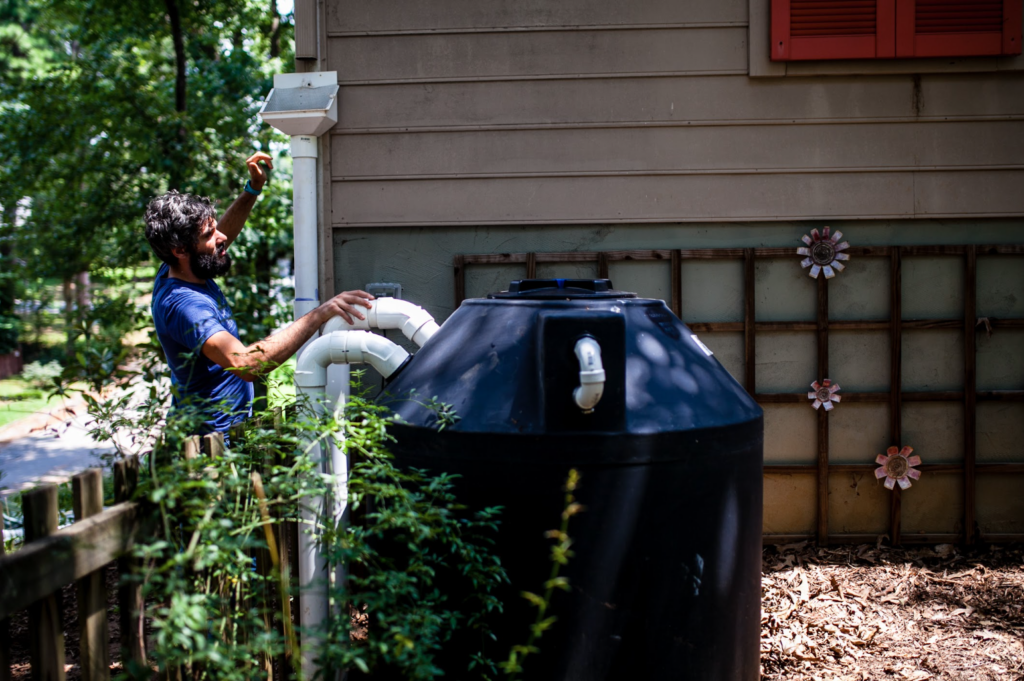
Whether your roof is asphalt or metal, every rainwater harvesting system needs occasional care.
Clean your gutters. Keep leaf screens clear. Check your tank every so often and remove built-up sediment when necessary.
Like healthy soil, a rainwater harvesting system isn’t maintenance-free—but it also doesn’t need to be complicated.
Regeneration Doesn’t Require Perfection
One of the things we love most about rainwater harvesting is that it reminds us of a larger truth. We often assume we need to buy something new before we can make a meaningful change.
A new roof. A bigger property. A more sophisticated system.
But regeneration almost always starts with paying attention to what we already have. If you have a healthy asphalt shingle roof, you’re already collecting thousands of gallons of rain every year.
The question isn’t whether your roof is perfect. It’s whether you’d rather that water rush into the nearest storm drain—or stay on your property, hydrating your soil, feeding your plants, and restoring a little more of the natural water cycle with every storm.
At Shades of Green, we know which one we’d choose.