



What if the water you’re trying to capture needs to go uphill?
At first glance, that might sound like a problem. Rain falls on the roof. Downspouts carry it toward the ground. Gravity wants to take it downhill and away. But in one of our residential landscapes, the best place to collect that water was actually uphill.
Rather than treating that elevation change as a limitation, we designed a system that worked with the physics of water—and used an inverted siphon to move captured rainwater uphill into a cistern located in the back courtyard.
It’s a great example of how regenerative landscape design often asks us to look at a site differently: not “How do we make the water do what we want?” but “What is the water already trying to do, and how can we design around it?”

The Challenge: Capturing Roof Water in the Right Place
The home had a valuable resource falling onto its roof every time it rained: rainwater. Instead of allowing that water to rush off the property through conventional drainage systems, we wanted to capture it and keep it on site for later use. The challenge was the location of the cistern. The ideal collection point in the backyard was higher in the back of the landscape from where we were capturing the downspouts. Normally, gravity-fed water systems depend on a continuous downhill flow. Water naturally wants to move from high points to low points. So how do you get water that has reached a low point back up to a higher collection point?
Enter the inverted siphon.

What Is an Inverted Siphon?
An inverted siphon is essentially a closed pipe system that allows water to travel through a low point and then rise again on the other side. Unlike a traditional siphon that carries water over a high point, an inverted siphon carries water through a lower elevation before rising to a higher point. The key is that the system needs to remain filled with water and sealed so that atmospheric pressure and the pressure created by the water column can allow the flow to continue.
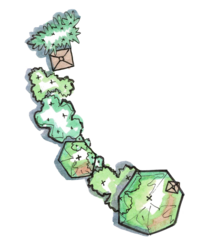
In our case, we used this principle to move rainwater from the downspouts, through the lower portion of the site, and uphill into the cistern.
The cistern itself wasn’t simply placed wherever gravity made the plumbing easiest. It was placed where it made the most sense for the landscape and the home’s water-management goals.

Why Capture Rainwater?
Every landscape has a water budget. Rain is one of the most abundant resources available to us, but conventional landscapes often move it off-site as quickly as possible.
That can mean:
- More stormwater runoff
- Increased erosion
- Lost soil moisture
- Less groundwater recharge
- Greater demand for municipal water
- Valuable nutrients and organic matter leaving the landscape
A regenerative approach asks a different question: How can we keep more of that water where it falls? Sometimes that means a rain garden or a dry creek bed. Sometimes it’s grading and earthworks. And sometimes it’s simply planting densely and building healthy soil that can absorb and hold more water. For this project, it means designing a more unconventional system for capturing and storing rainwater.

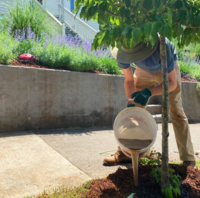
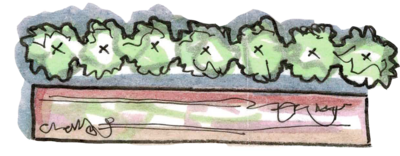
Tapped down spouts on either side of the house are captured at the stone patio level.
The Cistern: Turning Rainfall Into a Resource
Once the rainwater reaches the cistern, it isn’t immediately lost to the drainage system. Instead, it’s stored as a resource that can be used within the landscape. This is one of the fundamental ideas behind regenerative design: resources that would normally be considered waste can become inputs for another part of the system.
Rainwater becomes irrigation water and roof runoff becomes a resource. Water that might have left the property becomes part of the property’s water cycle. The goal isn’t simply to collect water, it’s to create a landscape that is better equipped to receive, hold, and use water over time.

Working With Water’s Intelligence
Water follows the path of least resistance. As landscape designers, we don’t need to overpower that tendency. We can observe it, understand it, and design systems that work within those natural forces. The inverted siphon didn’t make water behave unnaturally. It simply allowed us to work within the physics of water to accomplish a goal that gravity alone couldn’t accomplish at this site.
And that’s really the heart of regenerative landscape design.
We aren’t trying to force a landscape into submission, we’re listening to the land. We’re looking for the resources already present. We’re asking where energy, water, nutrients, and life are moving—and how we can design in ways that support those cycles rather than interrupt them. Sometimes that looks like a meadow. Sometimes it looks like a rain garden. And sometimes it looks like a pipe quietly carrying rainwater uphill into a cistern.
Good landscape design doesn’t always follow the easiest path. It follows the path that makes the whole system work better. Here’s a fantastic video of us visiting the site and explaining the design and process.